In the week since “Killing the Immortals” was released, I’ve been asked dozens of times by numerous people, “So, how are sales going?” These people generally mean well and are just trying to engage with me on the subject of the book, but the answer for pretty much all brand-new authors who have no real platform to sell from and are completely unknown outside a fairly small set of friends, family and acquaintances: “Predictably slowly.” I tend to tell people they’re “trickling in.” That’s pretty much right. It’s also pretty much exactly what I anticipated. There’s a reason new indie authors don’t just quit their day jobs once their book is out. Like any other small business, it takes a long time (and a good bit of luck) to build a following and a foundation for success. I’m a long way from that.
I don’t mind when people ask that. I’ve yet to punch anyone who did so, in fact. I make no promises, but it’s likely I won’t. But, in the interest of addressing the question, I thought I’d take a look at that in this post. Full disclosure and all. One of the things I never could find as I researched the business of publishing was an idea of reasonable expectations. This won’t solve that completely, but maybe it will help a bit. It’s a sample size of one, though, so bring your grain of salt with you. Here we go …
Kindle Sales
I’ll start here because this is probably the clearest of all the numbers I have. Amazon gives you all kinds of fun analytic tools, and it tells you exactly how many you’ve sold. In 10 days since the book went up online, I’ve sold 11 copies of the Kindle version at $2.99 each. That’s an average of about one per day, for you math geeks out there. Royalties for that come out to $25.24, so I’m clearly getting rich in a hurry. I’m your man if you need a loan.
Print Sales
These are a little tougher to pull in off the top of my head, since a lot of these sales have been in person, not just online. But I’ll give it a shot, anyway. I’ve sold eight print copies at $12.99 each through Amazon, bringing in royalties of $27.92. I’ve also sold another 21 signed copies via a Book Launch Party, my wife’s work friends, and the local Nextdoor board. Some of those were $8 each, and others were $10, with some people kindly choosing to pay more than I asked, because Yes, Virginia, there is a Santa Claus.
Kindle Unlimited
If you don’t know, Kindle Unlimited is basically a subscription service for books. You pay Amazon a monthly fee, and can check out up to 10 books at a time. In order to enroll your book in Kindle Unlimited, you have to give Amazon exclusivity on sales for 3 months. Then, they tell you how many “Kindle Edition Normalized Pages” subscribers have read. That’s to say, they have some method for making sure you don’t give your book 4-inch margins to get more pages read. As of this moment, Amazon says KU subscribers have read 1,289 pages of my book. Whether that’s good, bad, amazing, or indifferent is tough to say. But there it is. Given the print book is 288 pages, hopefully that means subscribers have read through the book a few times. Or 1,289 subscribers read one page each before giving up.
Rankings
These are actually pretty transparent. If you wanted to (and you most likely don’t), you could know as much as I do about this. Nobody knows quite how Amazon figures this stuff, but it’s all right there on your book’s Amazon page. Just scroll down a little bit, and you’ll see this:
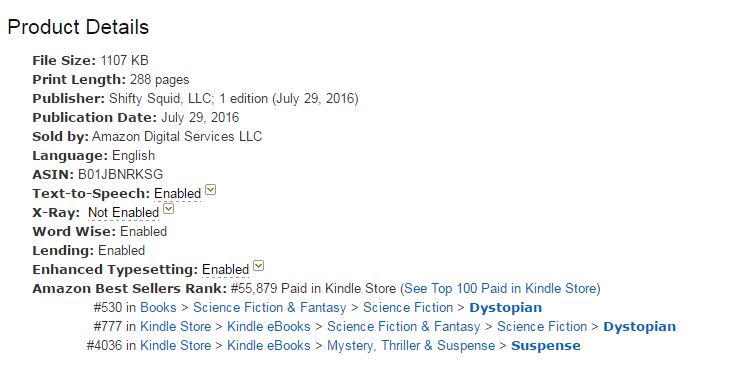
There ya go. A snapshot in time. As of this writing, that’s where my Kindle book stood, in relation to a whole hell of a lot of other books. That obviously factors in sales, but I think it also factors in Kindle Unlimited checkouts, and maybe KU pages read. It might also factor in how fancy I look in my headshot, but I cannot officially confirm that. What does all that mean? Who the hell knows? Obviously, I’m not going to knock the new Harry Potter book out of the sales rank any time soon. But there are plenty of books that are collecting cyber cobwebs out there, so I’m beating the pants off them.
And, of course, my in-person sales don’t count toward any of this. Rankings do matter, too. Lots of people look for books by checking out the best sellers in different genres they like. Higher rankings mean more visibility — or, at least, potential for visibility. If you are ever inclined to buy my book, it’d be great if you did it via Amazon. But I’m not exactly picky about that.
Sell Into the Future
So, what happens from here? I keep writing, of course. Like any small business, new revenue streams equal more opportunities to reach more customers. And once someone likes one book I produce, hopefully they’ll be more likely to check out the others. Maybe one hits somewhat big one day. If not, maybe I can write enough to produce steady income without any one of them hitting big. In the meantime, just write somehow, and know that new books by nobodies (generally) don’t sell jack — mine very much included.


Yes slow but steady! You’ll certainly see the stready sales as you keep talking about it and reaching new audiences! I love your transparency in this post.